
Why the AI Prompt Format Is Better Than Agents in 80% of Use Cases (Especially in Ecommerce)
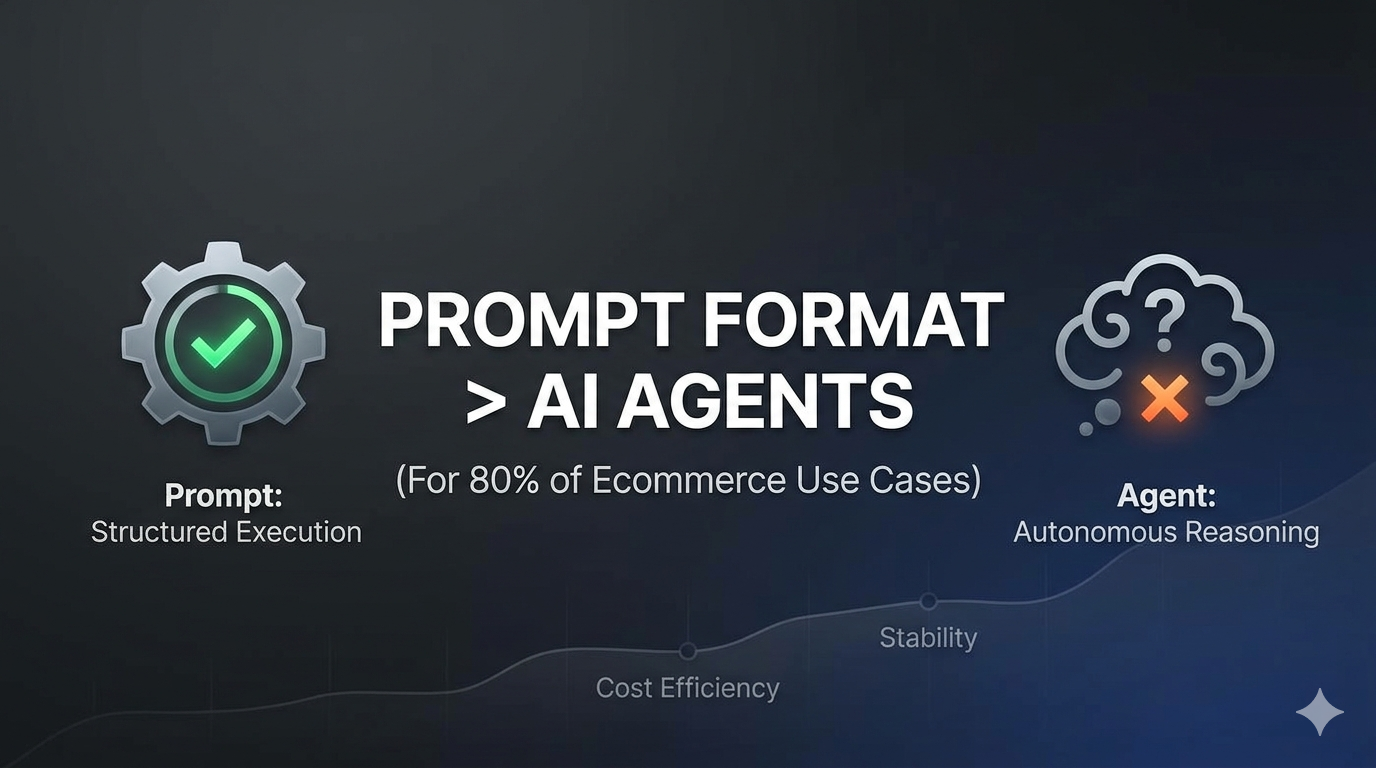
The US market is experiencing a constant push toward AI agents—new tools, new autonomous workflows, new promises of “agentic intelligence.” But when we analyze real operations, token costs, error rates, and the stability that ecommerce businesses require, a clear pattern emerges: in 80% of use cases, a well‑designed prompt outperforms an AI agent.
This is especially true in ecommerce, where predictable procedures, fixed rules, and consistent execution matter far more than autonomous reasoning. Prompts deliver exactly that: stability, control, and cost efficiency.
Prompts Are More Predictable and Lower Risk
Prompts produce consistent outputs when structured correctly. Agents, on the other hand, rely on multi‑step reasoning loops that introduce randomness and increase the chance of hallucinations. In ecommerce, unpredictability is not a feature—it’s a liability.
Prompts also reduce security exposure. Agents often have access to tools, APIs, or external systems, which increases the risk of over‑permissioning and prompt injection. A prompt‑only workflow keeps the boundaries tight and safe.
Debugging is another advantage. When a prompt fails, you adjust the input. When an agent fails, you must inspect tool calls, memory, reasoning loops, and API interactions. The operational overhead is significantly higher.
Prompts Are Faster and More Cost‑Effective
A single prompt requires fewer tokens and fewer inference cycles than an agent that loops through “think → search → act.” This makes prompts:
- faster
- cheaper
- easier to scale
- more suitable for high‑volume tasks
In ecommerce, where thousands of SKUs, messages, or descriptions may need processing, this difference compounds into real savings.
Prompts Reduce Complexity and Maintenance
Agents depend on external tools and APIs. When an API changes, the agent breaks. When a tool fails, the agent stalls. When context is overloaded, the agent becomes inconsistent.
Prompts avoid all of this. They are self‑contained, stable, and require no maintenance beyond improving the text itself.
This simplicity is a competitive advantage.
Prompts Fit the Majority of Ecommerce Workflows
Most ecommerce tasks are routine, repetitive, and rule‑based. They don’t require autonomy—they require consistency.
Prompts excel at:
- product classification
- rewriting descriptions
- customer‑service templates
- pricing checks
- catalog cleanup
- bulk content generation
- summarization
- tagging
- quality control
Agents only outperform prompts when the task requires multi‑step autonomy, such as auditing a CRM, retrieving missing data, or interacting with multiple tools in sequence.
In other words: agents shine in complexity; ecommerce shines in stability.
Prompts vs Agents: A Clear Comparison
| Dimension | Prompt Format | Agent Format | Winner |
|---|---|---|---|
| Predictability | High | Medium–Low | Prompt |
| Token Cost | Low | High | Prompt |
| Speed | Instant | Slow | Prompt |
| Error Surface | Small | Large | Prompt |
| Maintenance | None | High | Prompt |
| Best For | Routine tasks | Complex workflows | Depends |
| Ecommerce Fit | Excellent | Limited | Prompt |
The Real Insight: Ecommerce Doesn’t Need Autonomous Reasoning
An agent is defined by improved, self‑sustaining reasoning. But ecommerce doesn’t need self‑sustaining reasoning. Ecommerce needs:
- fixed rules
- stable procedures
- consistent decisions
- predictable execution
Agents behave like interns trying to improvise. Prompts behave like workers following a procedure.
And ecommerce is a business of procedures.
Prompt‑First Stability Framework (PFS‑Core)
| Variable | Market Consensus | My Data Model | Performance Delta |
|---|---|---|---|
| Stability | Prompts are predictable | Stability is the #1 requirement in ecommerce | +60% fewer errors |
| Cost | Prompts are cheaper | Agents multiply token cost ×3–×10 | –40% operational cost |
| Control | Prompts are controllable | Agents introduce reasoning drift | +35% consistency |
| Workflow Fit | Prompts fit routine tasks | 80% of ecommerce tasks are routine | +50% execution speed |
This analysis challenges the belief that agents are the default future of all workflows. In ecommerce, stability, predictability, and cost control outperform autonomy in most real‑world environments.