
The Expansion of AI in U.S. Ecommerce
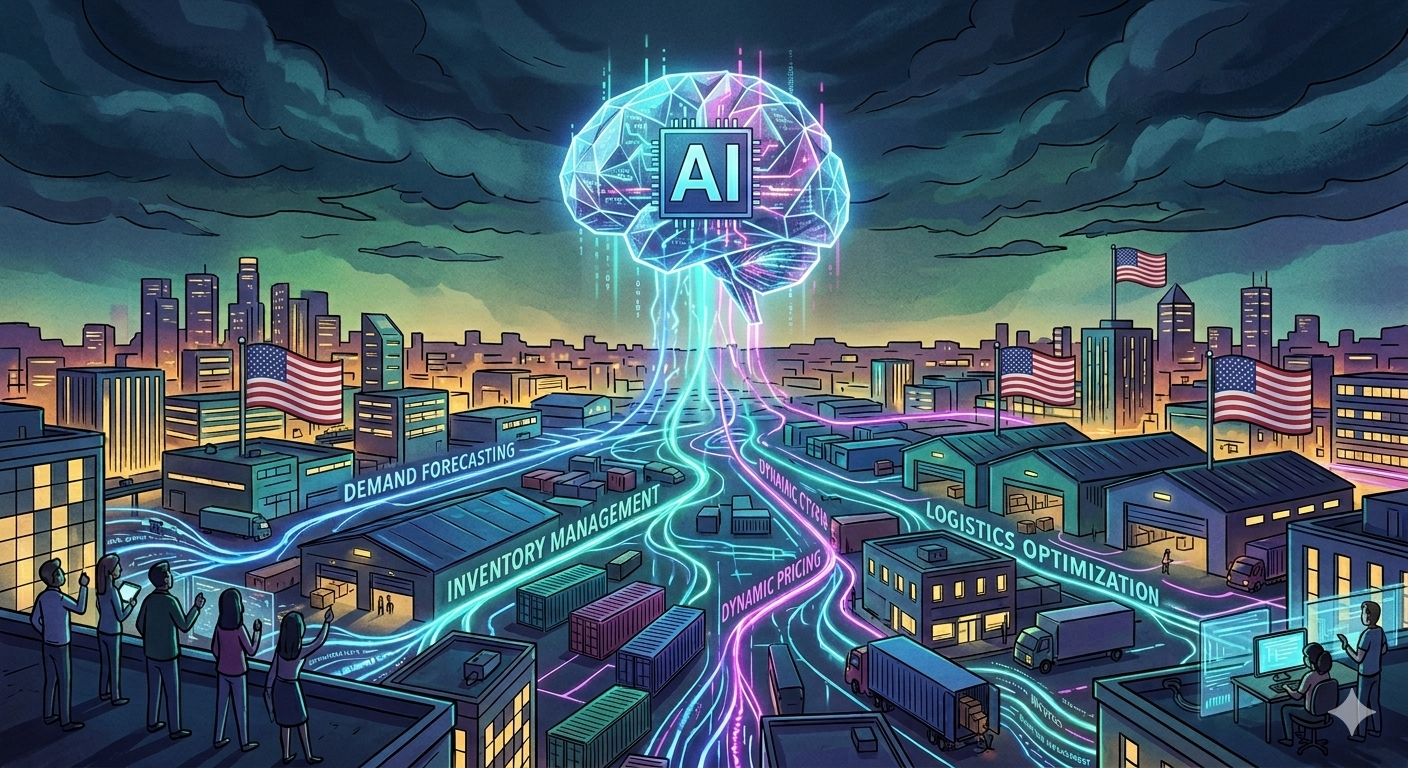
The adoption of Artificial Intelligence in American ecommerce is no longer a future hypothesis; it is a structural reality. AI is progressively integrating into five major layers of digital business: customer personalization, operational automation, predictive analysis, intelligent logistics, and commercial optimization. It acts not as a single tool, but as an ecosystem of systems working transversally across the entire value chain.
In major retailers and platforms, AI already serves as the decision engine in critical areas:
- Demand forecasting
- Inventory management
- Personalization of shopping experiences
- Dynamic pricing
- Customer service automation
- Logistics optimization
- Advanced user segmentation
- Purchase behavior analysis
In the U.S. market—where logistics is a competitive weapon and fulfillment defines the shopping experience—AI is integrated as infrastructure, not an accessory.
This growth is not merely a technological trend but a structural necessity. U.S. ecommerce has reached a level of complexity where manual management is no longer efficient. Extensive catalogs, multiple sales channels, hyper-segmented consumers, and constant pressure on margins force the adoption of systems capable of processing data at scale.
AI is entering ecommerce as infrastructure, much like ERPs, CRMs, or advanced analytics systems did in their time. It is becoming a base layer for business management. It is no longer about «using» AI; the system is beginning to depend on it to function efficiently.
While the dominant discourse speaks of mass adoption, operational reality in the USA shows that AI advances due to structural pressure on margins, logistics, and decision speed, rather than mere hype. However, this model was born in a very specific context: high data volumes, complex organizational structures, constant investment in technology, and standardized processes. It is an ecosystem designed for companies with financial muscle, technical teams, and integration capacity.
This leads to the first distortion in the narrative: what works as a structural system in large organizations is being sold as a universal solution for any ecommerce business, regardless of its size, margin, structure, or operational reality.
The expansion of AI in the USA is real, solid, and structural. But its form of adoption is neither homogeneous, automatic, nor linear.
Does AI Apply Equally to All Ecommerce? (Structure, Margin, and Operational Reality)
The short answer is no. And the long answer is even clearer: not all ecommerce businesses are structurally prepared for AI to provide real value. The problem is not the technology; it is the business context.
An ecommerce business is not just a website that sells products; it is a system composed of catalog, margin, turnover, logistics, operational structure, decision-making, and execution capacity. AI can optimize processes, but it cannot compensate for a weak business model, a poorly constructed catalog, or a structure lacking strategic criteria.
In practice, the real utility of AI depends on variables rarely mentioned in technological discourse:
- Catalog Size: A small catalog does not generate enough data volume for models to be truly predictive. AI does not «invent» demand; it analyzes existing patterns.
- Product Turnover: AI works best in high-turnover environments. In slow, seasonal, or highly specialized catalogs, patterns are weak, and models tend to overreact to isolated data points.
- Real Margin: If the margin is low, automatic optimization can increase volume while reducing profitability. AI optimizes metrics, not necessarily the business.
- Operational Structure: Automation requires clear processes. Without them, AI does not order chaos; it amplifies it.
- Execution Capacity: Detecting opportunities is not the same as being able to implement them.
- Decision Culture: In many businesses, decisions remain intuitive and centralized. AI does not replace a non-existent management culture.
The real question is not whether AI will grow in ecommerce—that is a fact—but in which types of ecommerce it adds structural value versus where it only adds complexity. In many cases, AI adoption does not solve underlying issues such as:
- Poorly prioritized catalogs
- «Dead» products that aren’t removed
- Inconsistent pricing
- Dependency on too few products
- Fragile operational structures
- Intuition-based decisions
AI can optimize healthy systems, but it does not turn a weak model into a solid one.
The Real Limit of AI in Ecommerce: Decisions That Remain Human
A common mistake is confusing movement with improvement. AI accelerates processes and automates repetitive decisions, but it does not improve the strategic quality of a decision if the model’s foundation is flawed.
Deep analysis, business interpretation, and structural decision-making remain human. AI executes, but it does not define the model. This is evident in companies grossing hundreds of millions of dollars annually that make conscious strategic choices:
- Companies with over $500M in revenue that consciously decide to charge for shipping.
- Businesses that do not force 24-hour delivery as a universal standard.
- Enterprises that prioritize margin and operational control over immediate conversion.
These are decisions of margin discipline and brand positioning. An algorithm doesn’t decide the brand experience you want to build or the margin model you accept; a CEO or a strategic committee does.
AI works on the system; it does not define the system. Automation multiplies execution, and data optimizes decisions, but the business model remains human. The true competitive advantage lies not in having more automation, but in having better foundational decisions.