
AI Image Generation Is Now a 500% Advantage for Ecommerce Catalogs in the USA
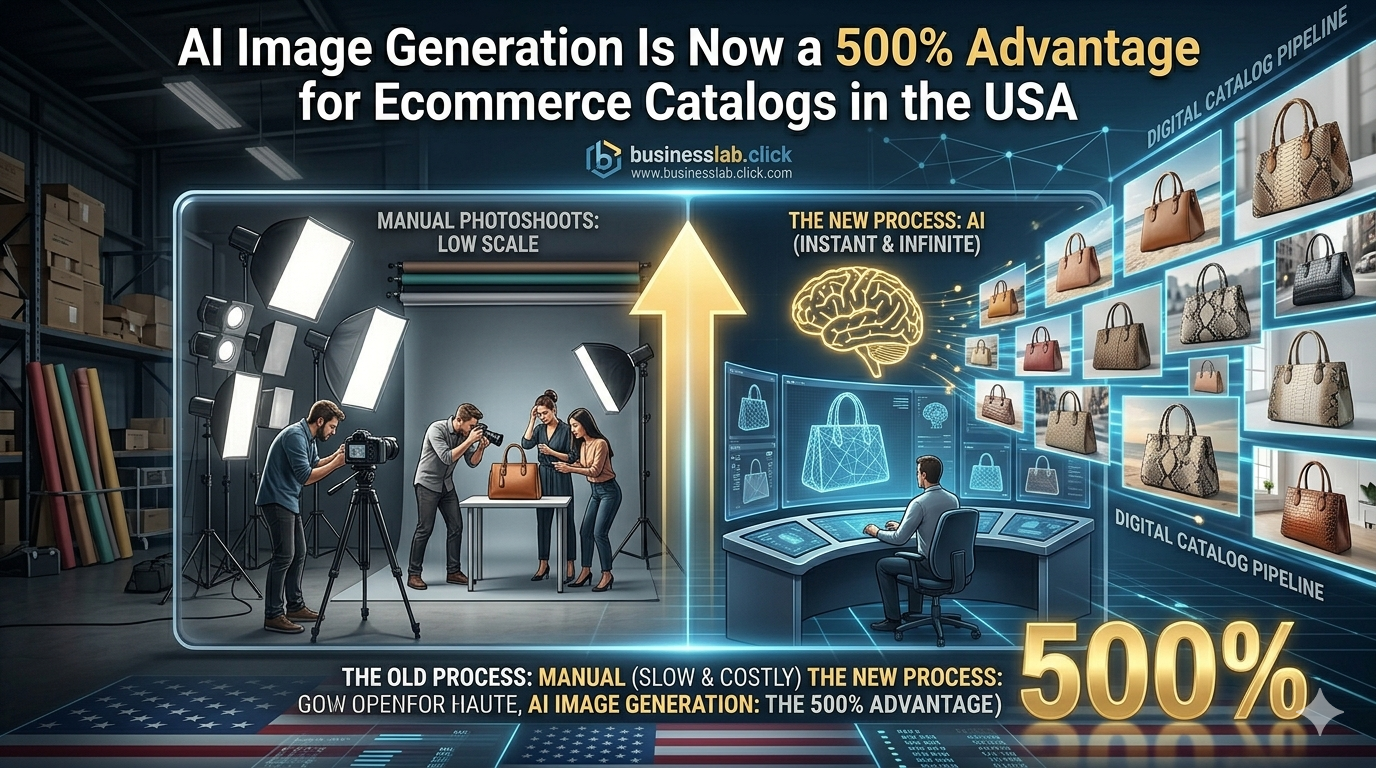
Until recently, creating personalized product photos was expensive, slow, and operationally impossible for most ecommerce businesses. A full photoshoot required models, lighting, locations, editing, retouching, and weeks of coordination. Today, that entire workflow has collapsed into minutes. AI image generation has become a 500% advantage for ecommerce, and the retailers adopting it first—especially in the USA—are already seeing the impact in conversion, catalog quality, and customer trust.
What was once unthinkable is now standard: generating complete visual ecosystems for every product, at scale, without photographers, studios, or production teams. The new catalog is not a set of photos; it is a visual system powered by generative AI.
The New Catalog: A Full Visual Experience Built by AI
AI allows ecommerce brands to create a complete set of images that cover every angle of the buying decision. The new standard includes:
- Primary Image: The core design model, clean, centered, and optimized for search and marketplaces.
- Secondary Image: A materials-focused shot that highlights texture, durability, and construction.
- Technical Image: A diagram-style visual showing features, specifications, and functional details.
- Feature Callout Image: Lines, labels, and markers pointing to each key benefit or use case.
- Lifestyle Image: The product in action—used by people, families, or in real environments.
- Contextual Image: The product placed in a realistic setting that communicates scale and purpose.
This format is heavily used by Amazon’s top sellers because it increases conversion, reduces returns, and builds trust. AI now makes this format accessible to every ecommerce business, regardless of size.
Why AI Images Convert Better Than Traditional Photography
AI-generated visuals outperform traditional photos because they solve the biggest problems in ecommerce:
- Consistency: Every product follows the same visual system.
- Speed: New images can be created in minutes, not weeks.
- Cost: No studios, no models, no logistics.
- Precision: Every detail can be highlighted exactly as needed.
- Variation: Multiple styles, angles, and environments can be produced instantly.
- Testing: Brands can A/B test visuals at scale without additional cost.
A product shown in action—being used by a person, a family, or in a real scenario—converts significantly better than a static, isolated object. AI makes this possible for every SKU, not just the top sellers.
The Hidden Power: AI Images + AI Descriptions + Curated Prompt Models
The real advantage appears when image generation is combined with:
- precise product descriptions,
- brand‑specific prompt models,
- structured data extraction,
- and ad‑linked visual variants.
This creates a complete system where:
- the catalog is visually consistent,
- the descriptions match the visuals,
- the prompts follow brand rules,
- and the ads link directly to the exact product variant shown.
This is the first time ecommerce brands can create fully aligned visual + textual product ecosystems without human bottlenecks.
Why US Ecommerce Is Leading This Shift
The USA is the fastest market in the world to adopt generative AI for ecommerce. Retailers are:
- testing new formats weekly,
- integrating AI into catalog workflows,
- optimizing product pages with visual systems,
- and measuring conversion improvements in real time.
The cycle of innovation is extremely fast. The feedback loop is immediate. The competitive pressure is high.
This is why US ecommerce brands are the first to see results: they are not waiting for perfect tools—they are testing, iterating, and scaling.
AI Image Generation Is Not a Trend—It’s the New Catalog Standard
The ecommerce catalog of the future is:
- visual
- dynamic
- personalized
- scalable
- consistent
- conversion‑driven
And none of this is possible without generative AI.
The brands that adopt this system now will dominate the next decade of ecommerce. The brands that delay will be stuck with catalogs that look outdated, incomplete, and uncompetitive.